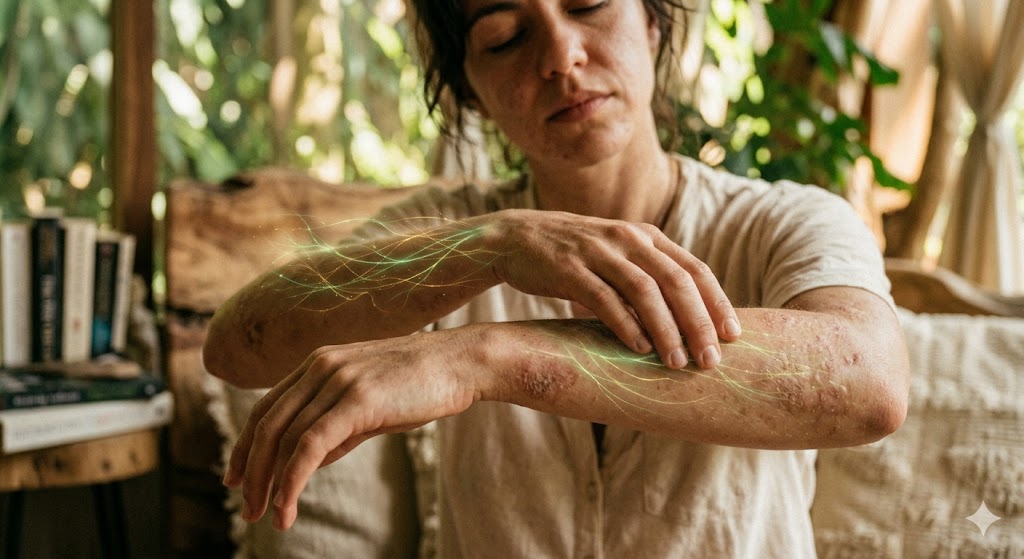
If you are staring at your phone screen right now with raw, burning, angry skin, I want you to take a deep breath with me. Just let your shoulders drop. I know exactly where you are right now. I know that terrifying, overwhelming panic when an intense flare-up hits and your entire body feels like it’s on fire.
You’ve probably been told by doctors to “just stop scratching” or to lather on yet another tub of heavy steroid cream. But let’s be honest: when you’re in the middle of a brutal skin crisis, trying to use pure willpower to stop scratching feels completely impossible. It’s a desperate, primal reflex.
For years, I fought my own skin like it was my worst enemy. Every flare-up felt like a personal failure, a betrayal by my own body. I would look in the mirror with so much anger, frustration, and tears in my eyes, screaming inside, why is my body doing this to me?
But through my own painful journey, I finally realized a profound truth: my skin wasn’t failing me. It was trying to talk to me. When we live in a state of chronic stress, hypervigilance, or trapped emotional trauma, our nervous system locks into “Fight or Flight” survival mode. My brain was sending emergency chemical signals directly into my skin tissues, causing my nerve endings to explode in fire. It wasn’t an epidermal failure; it was a neurological cry for help.

To stop the fire, I had to stop fighting my body from the outside in. I had to learn how to speak directly to my nervous system in its native language—the language of physical safety. These are the exact, raw somatic exercises for eczema flare ups that saved me, regulated my system, and allowed my skin to finally heal.
How I Learned to Stop Fighting and Start Listening
When a severe itch hits, trying to force your hands to stay still actually makes the internal tension worse. It spikes your cortisol and accelerates the burning. That’s because you’re trying to use logic on a primitive survival brain that feels completely unsafe.
Somatic healing changed everything for me. “Soma” simply means the living body. Instead of trying to fix my mind to fix my skin, I started using my physical body to send safety signals back up to my brainstem. By changing my posture, slowing my breath, and gently holding myself, I learned how to stop a stress itch cycle right in its tracks by rewriting my internal chemistry on the spot.
My Secret Weapon: Vagus Nerve Regulation for Chronic Eczema
The absolute turning point in my recovery journey was learning about vagus nerve regulation for chronic eczema. The vagus nerve is the long, beautiful highway of your “Rest and Digest” nervous system. It winds from your brainstem all the way down through your neck, heart, and gut, acting as your body’s built-in cooling mechanism.
When we are constantly flaring, our vagus nerve is exhausted. We lose our natural ability to put the brakes on inflammation. The following movements are my personal daily rituals. They are the exact tools I use to manually activate that cooling system, forcing my body to drop its shields so my skin can finally rest and repair.
The 3 Somatic Movements that Save My Skin Every Time
The next time you feel the heat rising or find your fingers helplessly reaching to scratch, I want you to put down the creams for a moment and try these three steps with me.
1. The Lateral Eye Reset (My Neurological Circuit Breaker)
This one felt strange to me the first time I did it, but it works instantly because your eyes are a direct, structural pathway to your brainstem.
- What I do: I sit up comfortably, keeping my head facing perfectly straight ahead. Without turning my neck at all, I shift my eyes as far to the right as they can possibly go, looking toward my right ear.
- The Release: I hold my gaze there for about 30 to 60 seconds. I just breathe and wait. Suddenly, my body will let out a spontaneous, deep sigh, a wide yawn, or a clear swallow. That is the physical proof that my autonomic nervous system has successfully dropped out of fight-or-flight. Once I feel that shift, I bring my eyes back to center and repeat it by looking far to the left.
2. The Somatic Containment Hold (Creating My Own Safe Boundary)
When my skin is flaring, I feel completely exposed, broken, and out of control. My skin is struggling to maintain its physical barrier, so I use my hands to create that boundary of safety for it.
- What I do: I tuck my right hand snugly underneath my left armpit, right against my ribs. Then, I take my left hand and wrap it firmly over my right upper arm or shoulder.
- The Feeling: I close my eyes and give myself a warm, steady, grounding squeeze. I hold myself tight and breathe into my hands. This physical containment tells my survival brain: I’ve got you. You are contained. You are safe right here. I stay like this for 2 to 3 minutes until the urgent, frantic panic of the itch begins to melt away.
3. The Auricular Vagus Nerve Massage
A major branch of the vagus nerve passes right through the skin of your ears, especially in that deep, little hollow bowl right outside your ear canal.
- What I do: I place the pads of my index fingers gently into the hollow bowl of my ears. I close my eyes and begin making very slow, gentle, circular motions. I let my jaw go completely loose and slack. Then, I take my earlobes between my thumbs and fingers and gently pull them downward and slightly outward away from my skull. I can feel the tension draining from my face almost instantly.
To amplify this vagal massage, I love applying a drop of Vibrant Blue Oils Parasympathetic Blend right behind my ear lobe on the mastoid bone before I start. It’s an organic formulation specifically designed to stimulate the vagus nerve and help trigger that shift out of fight-or-flight.
Note: While your skin is raw or compromised during a flare, keep the oils strictly behind the ear on the bone pathway where the nerve sits, and use your trusted Lyonsleaf Zinc and Calendula Cream directly on the broken skin patches to soothe the physical heat.“
Shifting the Internal Narrative
The hardest part of this journey was breaking the mental loop. The second an itch would start, my mind would spiral into absolute despair: “Oh no, not again. I’m destroying my skin. I won’t sleep tonight.” That emotional panic was feeding adrenaline straight into my flares.
To break it, I had to practice something called Somatic Tracking.
Instead of looking at my flaring skin with hatred or disgust, I forced myself to close my eyes and look at the sensation with total curiosity, like a scientist. I stripped away the word “itch” and asked myself neutrally: Is this vibrating? Is it pulsing? Is it a sharp prickle or just ambient heat?
By observing the sensation without adding the emotional panic, I showed my brain that the fire wasn’t an enemy attack. The emergency broadcast inside my head shut off, and the overwhelming urge to rip at my skin lost its power.
Walking the Path to Safety Together
Healing our skin isn’t a quick fix or a battle to be won with a stronger prescription. It is a daily, heart-centered practice of re-patterning how we inhabit our own bodies. My skin was an exquisite messenger telling me where I was suppressing my voice, failing to set boundaries, or living in environments where I didn’t feel safe.
As you do this internal somatic work, please treat your exterior with the exact same deep respect.
I completely threw out all the ultra-processed commercial lotions loaded with synthetic chemicals and fragrances that were irritating my compromised barrier. I switched to purely minimalist, clean, biocompatible botanical balms that work in harmony with my body’s natural lipid structure.
Be incredibly gentle with yourself today. Your skin is listening to every wave of tension you hold, but it is also listening to every signal of love and safety you give it. Let’s take our power back from the flare-ups, together.

Disclaimer: I am a natural health blogger and advocate sharing my personal research and journey toward skin healing; I am not a medical professional. This content is for educational and informational purposes only and should not be taken as medical advice. Always consult with a qualified healthcare provider before changing your skincare routine or managing chronic skin conditions.
Leave a Reply