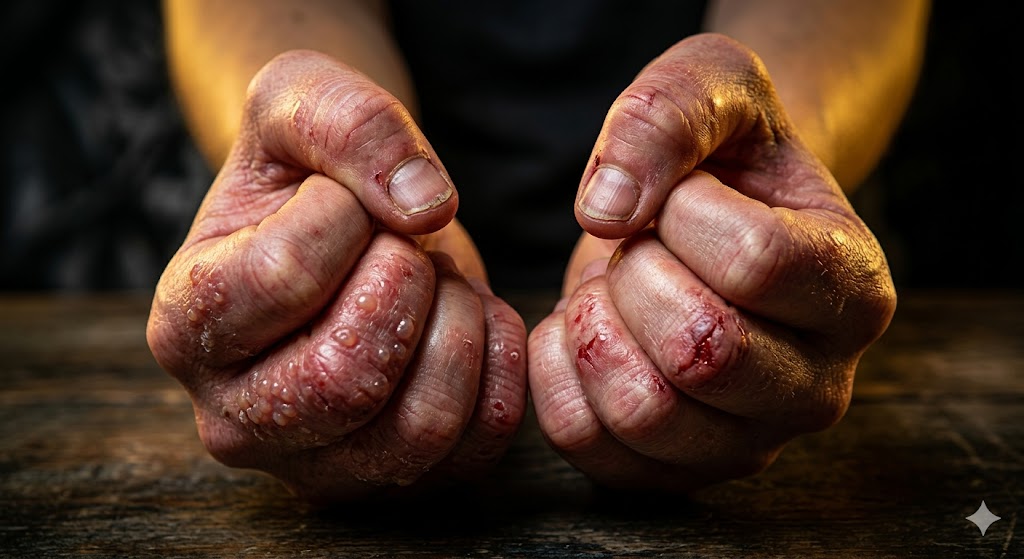
Look at your palms right now. Look at those microscopic, fluid-filled “bubble wrap” blisters cracking open your fingers, and answer me honestly: What in your life are you desperately trying to control so tightly that your skin is literally screaming and exploding from the pressure?
Go ahead and let out that breath you didn’t realize you were holding. I know exactly how exhausting it is.
I remember sitting at my desk late one night, my chest tight with baseline anxiety, frantically staring at a mountain of work. Out of nowhere, it hit me—that deep, primal, maddening itch crawling beneath the thick skin of my palms. It didn’t feel like a surface itch. It felt like it was vibrating straight out of my bones, an electrical current running down my arms.
When I turned my hands over under the harsh light of my desk lamp, my heart completely sank. There they were: rows of tiny, deep-set blisters glistening like clear liquid beads beneath the skin.

Within forty-eight hours, the nightmare always played out the exact same brutal way. The blisters would pop, the fluid would dry, and my hands would transform into a stiff, splitting, bleeding landscape. Washing my hands felt like pouring acid on raw meat. Chopping vegetables for dinner was an exercise in pure agony.
But the psychological humiliation was what broke me. I found myself instinctively hiding my hands in my pockets during conversations. I awkwardly pulled my sleeves down over my knuckles when handing cash to a store cashier, completely paralyzed by the thought that they were looking at my raw, peeling fingers with disgust.
In my desperation, I fell into the exact retail traps the internet corporate blogs push. I bought specialized, expensive sensitive hand soaps. I slathered my fingers in suffocating petroleum jellies and pulled on a pair of white cotton gloves before bed, lying there looking like a tragic magician, praying I’d wake up to a miracle.
But the miracle never came. The very second another wave of life stress or emotional overwhelm hit my mind, the bubble wrap returned with an absolute vengeance.
It took me years of heartbreak, bleeding skin, and nervous system exhaustion to finally face the raw truth peer-to-peer: No amount of cotton gloves or top-of-the-line creams were ever going to heal my hands permanently, because I was completely ignoring what my nervous system was screaming at me. My hands weren’t failing me. They were acting as a flawless somatic mirror for a body trapped in a state of high-alert survival. Let me show you what I discovered about what I now call the Sympathetic Grip.
The Breakthrough: Why the Fire Maps to Our Hands
When I first started searching for answers, mainstream medical sites casually tossed around terms like dyshidrotic eczema or pompholyx. They told me it was a random skin glitch caused by sweating or seasonal allergies. But as I dove deeper into ancestral healing and somatic therapy, I realized something profound: the human body does not make mistakes, and it does not break out in highly specific geographical patterns without an explicit biological reason.
I had to ask myself: Why my hands? Why not my back, my legs, or my shoulders?
From a somatic perspective, our hands represent our agency, execution, and control. Our hands are the literal physical tools our brains use to grab onto our world, build our lives, manipulate our environments, and forcefully keep things from falling apart.
When I mapped out my own flare-ups, the patterns were undeniable. My hands didn’t break out when I changed soaps; they broke out when I felt completely overwhelmed, trapped, or felt like my life was spinning out of my control.
The moment my mind tripped into a severe state of chronic anxiety, my autonomic nervous system went straight into a survival fight-or-flight response. Subconsciously, my brain believed I was in imminent danger, and it commanded my body to physically hold on tighter.
This is the Sympathetic Grip. Even when I thought I was sitting completely still on the couch, my autonomic nervous system was structurally clenching. It was sending a massive surge of localized nerve energy, heat, and histamines directly down my arms and into the thick, nerve-dense tissue of my palms. Those microscopic blisters weren’t a random skin disease—they were trapped inflammatory fluid pooling under the surface because my skin barrier was literally short-circuiting under the heavy electrical load of my chronic stress.
How I Broke the Grip and Reclaimed My Hands
Once I understood the root cause, I realized that suffocating my blistering hands under heavy, synthetic corporate lotions was actually trapping that internal, systemic heat inside and making the inflammation worse.
To permanently clear my skin, I had to stop treating my hands like a broken surface and start teaching my nervous system that it was safe to release its grip. Here is the exact two-step mind-body routine I used to finally calm the neurological fire running down my arms:
1. The Somatic Discharge Shake
The moment I feel that deep, frantic bone-itch starting to crawl back into my fingers, I actively force myself not to scratch. I know that scratching sends an immediate danger echo straight back to the brain, which only accelerates the flare-up.
Instead, I drop my hands completely to my sides. I take a deep, slow breath in through my nose, and as I blow the air out through my mouth, I begin to vigorously shake my hands and wrists out. I pretend I am physically flicking water off the tips of my fingers. I do this for a full 60 seconds. Shaking is an ancestral biological mechanism that animals instinctively use to discharge excess sympathetic energy after surviving a threat. For me, it acts like a physical release valve, telling my nervous system: The emergency is over. You can let go of the control.
2. Shielding the Raw Tissue with Bio-Identical Lipids
Once the blistering phase ends and the skin transitions into that dry, splitting, painful cracking phase, the superficial nerves sit completely exposed to the elements. I stopped using drugstore hand lotions completely, because their high water content and chemical preservatives caused an immediate, blinding sting that sent my nervous system right back into panic mode.
Instead, I started coating the raw tissue in a pure, water-free ancestral fat profile like grass-fed beef tallow infused with whole-plant calendula. Because it perfectly mirrors the biological architecture of our human sebum, it absorbs deeply without a single laboratory stabilizer, wrapping those raw, exposed nerves in an environment of total peace so the skin layers can safely knit back together.
To see the exact side-by-side molecular breakdown of how I use these ancestral fat barriers to heal deep, raw tissue cracks without triggering a nerve shock, read my master guide: Calendula vs Tallow for Eczema: Which One Actually Heals Your Skin Barrier?.
The Takeaway
My hands were never my enemy, and they were never broken. They were simply trying to physically manifest the immense internal pressure, stress, and desperate desire for control that I was carrying around in my head.
The next time your fingers break out in those telltale, blistering circles, I want you to step back from the medicine cabinet. Take a deep breath, look at your life, and ask yourself what you are subconsciously trying to grip onto so tightly. By practicing physical somatic discharge exercises and insulating the surface with unadulterated, bio-identical nutrition, you give your nervous system the ultimate green light to finally open its hands, release the pressure, and let the skin clear from the inside out.

Disclaimer: I am a natural health blogger and advocate sharing my personal research and journey toward skin healing; I am not a medical professional. This content is for educational and informational purposes only and should not be taken as medical advice. Always consult with a qualified healthcare provider before changing your skincare routine or managing chronic skin conditions.
Leave a Reply