I know exactly where you are right now. You’re staring at your skin, feeling that familiar, agonizing heat starting to crawl up your arms or neck. Your heart is racing, your chest feels tight, and the itch is so intense it feels like it’s vibrating under your skin. You want to tear at it. You want to scream.
And the absolute worst part? You know this flare-up started because you’re stressed out, which makes you stress out even more, creating a vicious, cruel loop that feels impossible to escape.
For years, we’ve been told that eczema is just a “surface problem.” Just put some more cream on it, they say. But you and I know the truth: our skin is a mirror of our internal world. When your life or your mind feels like a chaotic war zone, your skin flares up in solidarity.
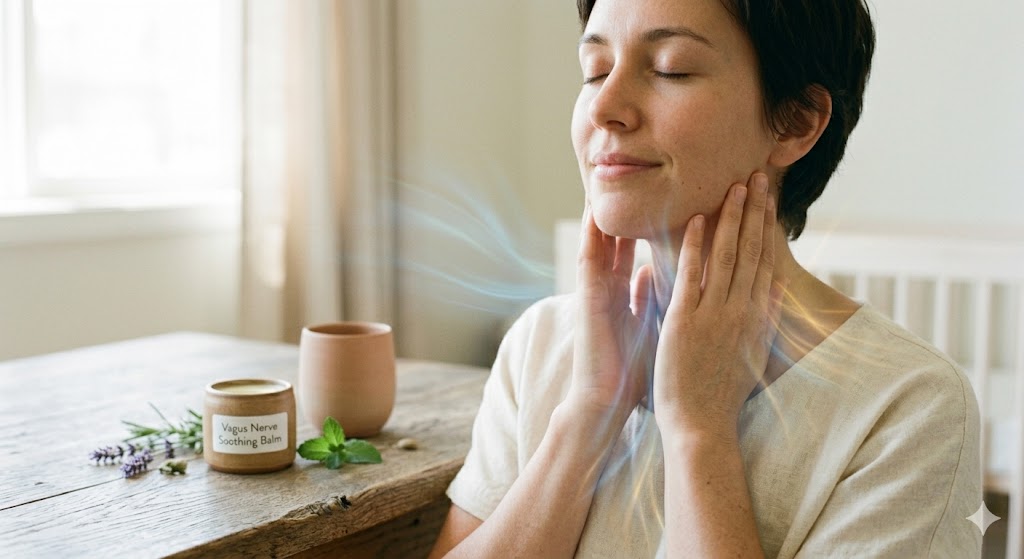
Today, let’s stop fighting the surface and talk about a beautiful, hidden highway inside your body that can instantly flip the switch from panic to peace: the vagus nerve.

You don’t need money, you don’t need a doctor’s appointment, and you don’t need another burning chemical cream. You just need a few minutes to breathe and remind your body that it is safe.
Why Your Body is Stuck in “Fight or Flight”
Let’s keep it incredibly simple. Your nervous system has two main modes: “Fight or Flight” (panic/survival) and “Rest and Heal” (peace/repair).
When you have chronic eczema, your system gets stuck in survival mode. Your brain genuinely believes you are in physical danger. Because it’s trying to protect you from an invisible threat, it starts sending panic signals everywhere.
On the surface, this internal panic causes your skin cells to release a flood of histamines and inflammatory chemicals. The blood rushes away from your skin barrier, leaving it dry, exposed, and intensely itchy.
The master volume control for this entire system is the vagus nerve. It’s the longest nerve in your body, wandering all the way from your brain down to your gut. When this nerve is healthy and active, it acts like a soothing balm from the inside out, releasing chemicals that literally tell your immune system: “Hey, calm down. The danger is gone. We can stop burning the house down now.”
If you are trapped in a flare-up right now, we need to manually turn that vagus nerve back on. Here are three incredibly simple, gentle things you can do right this second to find relief.
3 Gentle Resets to Stop an Active Itch Loop
You don’t need to be a yoga master to do these. Sit down, drop your shoulders away from your ears, and let’s do them together.
1. The Eye Shift (The Basic Reset)
The vagus nerve passes right behind your neck muscles and eyes. By moving your eyes in a very specific way, you can physically trick your brain into a state of deep safety.
- Sit comfortably and interlace your fingers behind your head, letting your skull rest heavily in your hands.
- Keep your nose pointing straight ahead. Do not turn your head.
- Now, shift just your eyes as far to the right as they can go. Look at the corner of the room.
- Hold them there. Keep looking right. Within 30 to 60 seconds, you will notice your body automatically take a sudden deep sigh, a swallow, or a yawn. That is the exact moment your vagus nerve turns back on.
- Bring your eyes back to center, and repeat it by looking all the way to the left.
2. The Low Hum (Vocal Vibration)
Your vagus nerve wraps directly around your vocal cords and throat muscles. Physical sound vibrations stimulate the nerve endings instantly.
- Drop your jaw and take a slow, easy breath deep into your belly.
- As you let the air out, close your lips and make a low, deep humming sound. Make it rattle in your throat.
- Keep the hum going for as long as you can breathe out. Feel the vibration shaking through your chest and your neck.
- Do this 3 or 4 times. It sounds silly, but it physically forces your racing heart to slow down and stops the intense itch-panic in its tracks.
3. The Emergency Double Inhale
When the anxiety of a flare-up makes you feel like you can’t catch your breath, use this quick breathing tool to shock your system back to reality.
- Take a deep, sharp breath in through your nose.
- At the very top of that breath, snap in one more tiny sniff of air to fully expand your lungs.
- Hold it for just one second.
- Let it out through your mouth with a long, slow, heavy sigh.
- Do this just three times. It instantly unloads stress from your bloodstream and calms the frantic signaling to your skin.
Tying It All Together: Inside and Out
Regulating your nervous system is the ultimate secret to long-term healing, but while you are doing the beautiful, messy internal work, you still have to protect the physical barrier on the outside.
When your skin is raw, you cannot afford to put water-based chemical lotions on it that sting and burn. You need simple, ancestral lipids that wrap your skin in a gentle hug while your mind learns to feel safe again.
Our Sacred Skin Routine: If you want a deeper set of physical tools to release trauma and tension from your muscles, take a look at our heart-centered guide on using somatic exercises for eczema flare ups. Once your internal system feels calm, you can protect your outer shield with ancestral moisture. Read our story on why pure grass-fed tallow balm is safe for babies and sensitive skinto see how simple, water-free nutrition can change everything.
The Science of Our Interconnected Bodies
This isn’t a trendy wellness fad; it’s how our bodies were beautifully designed to function.
Clinical studies shared by the National Institutes of Health (NIH) show that emotional and psychological stress directly fractures the lipid barrier of our skin, causing us to lose vital moisture. Even medical networks like the National Eczema Association acknowledge that healing the mind-body connection is a non-negotiable step if we ever want to find lasting relief from the itch cycle.
You do not have to live at the mercy of your skin flares anymore. Your body isn’t broken—it’s just overwhelmed, and it’s crying out for a little bit of safety.
You are Safe, and You Can Heal
Take it one breath at a time, friend. The next time you feel the heat rising, put your hands behind your head, shift your eyes, and remind your nervous system that the storm has passed.
To see the exact, completely clean, non-chemical botanical ointments and balms we use to protect our skin during this healing journey, come spend some time over on our Recommended Remedies Page.

Disclaimer: I am a natural health blogger and advocate sharing my personal research and journey toward skin healing; I am not a medical professional. This content is for educational and informational purposes only and should not be taken as medical advice. Always consult with a qualified healthcare provider before changing your skincare routine or managing chronic skin conditions.
Leave a Reply